one-stop rfid hardware solution provider.

Leave A Message
If you are interested in our products and want to know more details,please leave a message here,we will reply you as soon as we can.


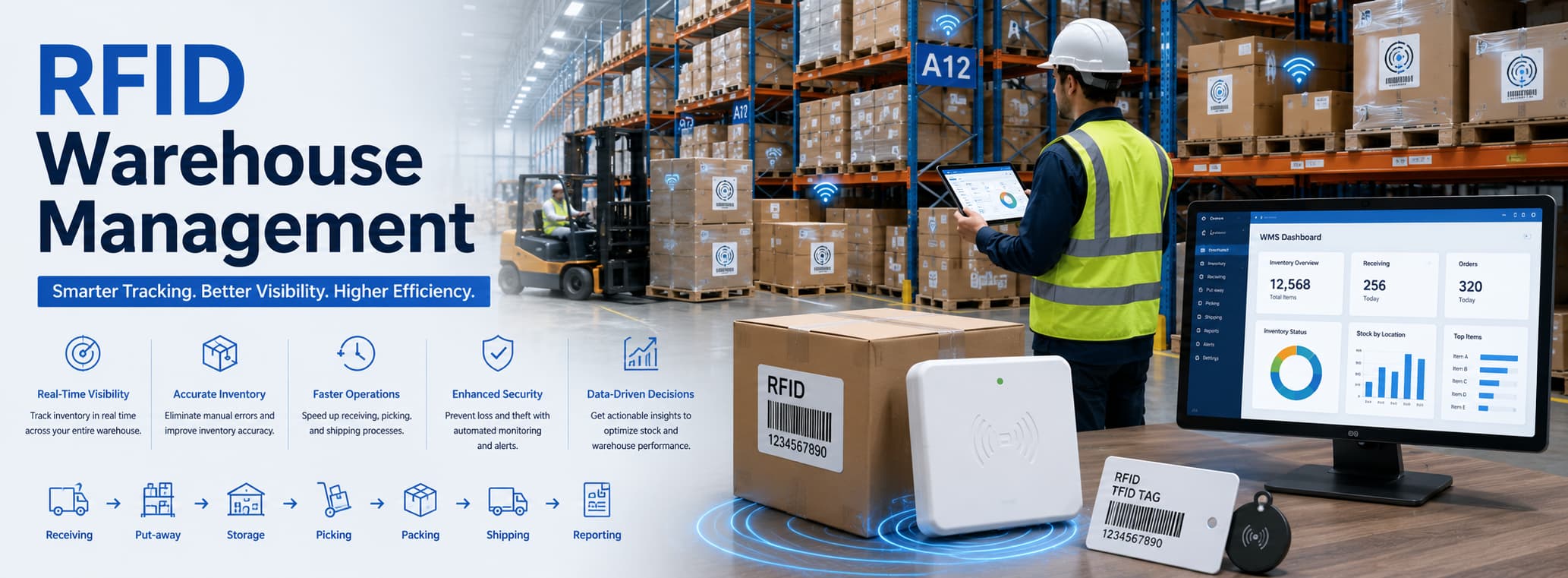
Efficient warehouse management is the backbone of modern supply chains. As businesses handle increasing volumes of inventory and customer orders, traditional inventory management methods—such as manual counting or barcode scanning—often struggle to keep pace. These methods can lead to inventory inaccuracies, delayed shipments, and increased labor costs.
RFID Warehouse Management offers a smarter, automated solution by providing real-time visibility into inventory movement, storage locations, and warehouse operations. With RFID technology, businesses can streamline workflows, improve inventory accuracy, and increase overall warehouse productivity.
RFID Warehouse Management is an intelligent inventory management system that uses Radio Frequency Identification (RFID) technology to automatically identify, locate, and track goods throughout warehouse operations.
Each product, carton, pallet, or container is equipped with an RFID tag containing a unique identification number linked to the Warehouse Management System (WMS).
Common tracked assets include:
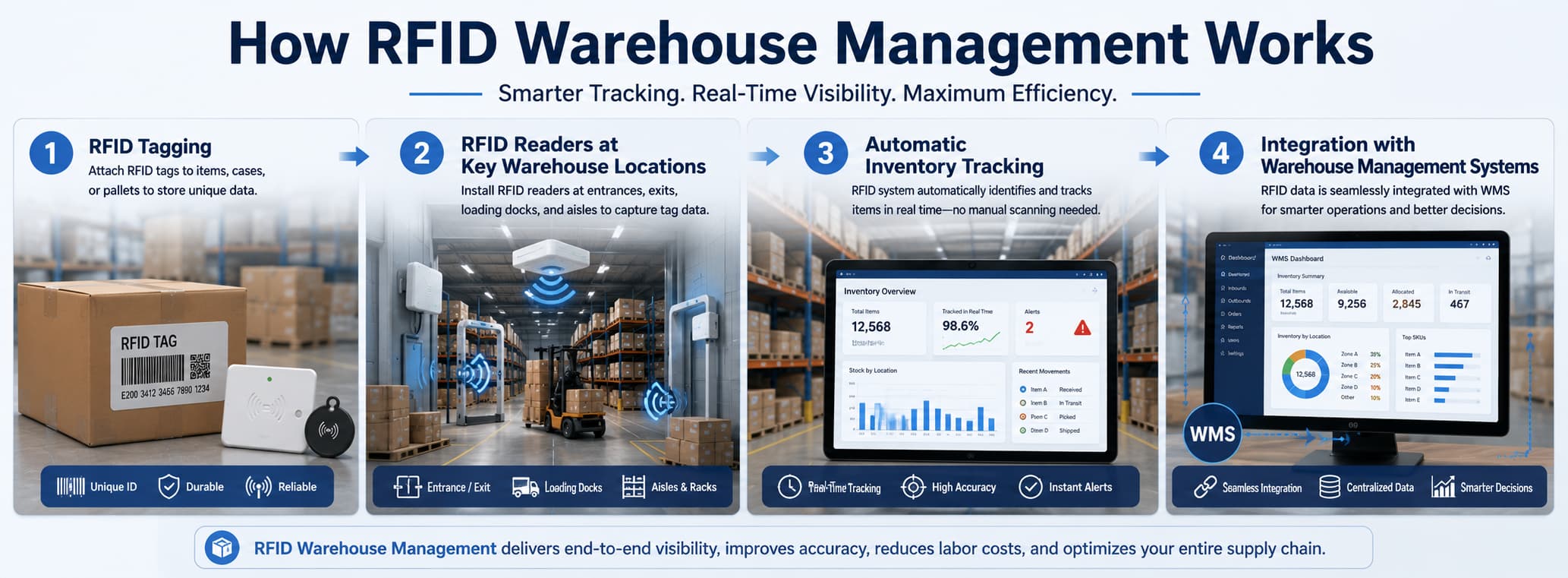
A complete RFID warehouse solution consists of several integrated components.
Products or logistics units are tagged before entering the warehouse.
RFID tags may be attached to:
Each tag stores a unique identifier associated with inventory information.
RFID readers are installed throughout the warehouse, including:
These readers automatically capture inventory movement without manual scanning.
As tagged goods move through the warehouse, RFID readers automatically record:
Inventory records are updated in real time.
RFID integrates seamlessly with:
This enables end-to-end warehouse visibility.
Warehouse managers can instantly locate inventory without manual searching.
Benefits include:
RFID significantly reduces inventory discrepancies by:
Many warehouses achieve inventory accuracy rates above 99% after implementing RFID.
RFID accelerates inbound and outbound logistics by enabling:
This shortens processing times and improves customer satisfaction.
Warehouse staff spend less time on repetitive tasks because RFID automates:
Employees can focus on higher-value activities.
RFID helps prevent inventory loss through:
With accurate inventory data, businesses can:
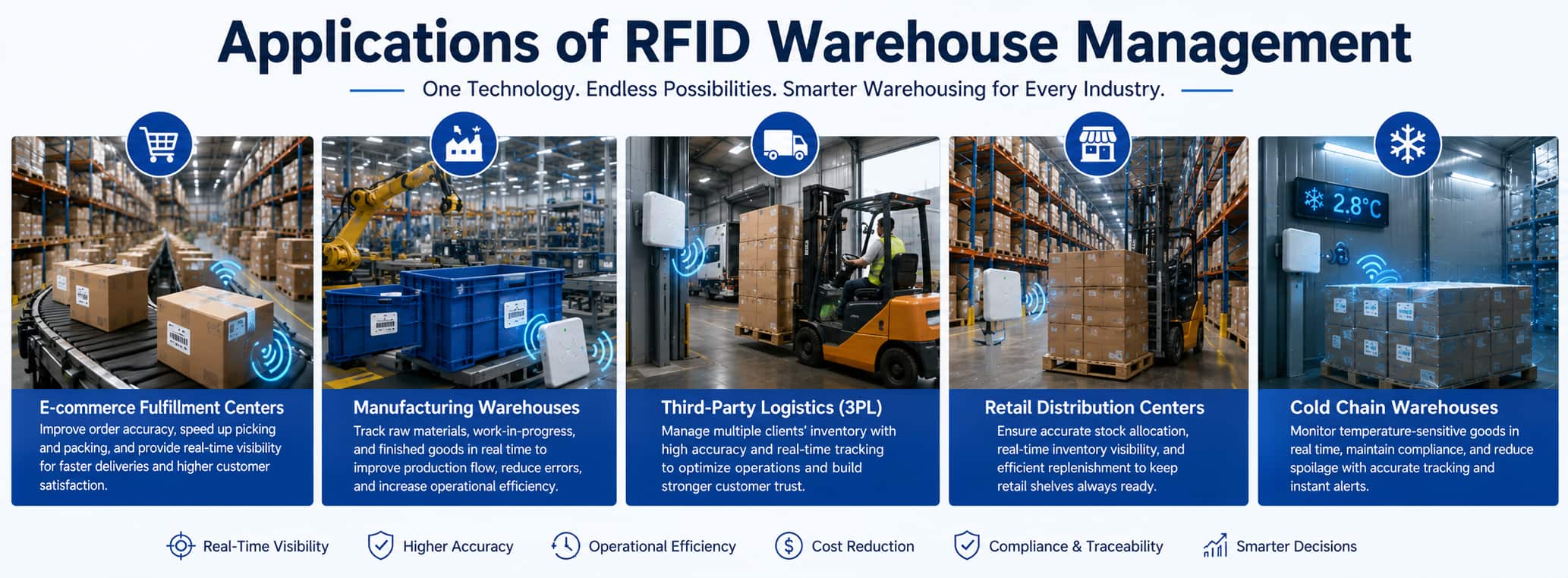
Improve order accuracy and accelerate same-day shipping.
Track raw materials, components, and finished goods throughout production and storage.
Provide real-time inventory visibility for multiple clients.
Manage high-volume inventory with fast receiving and dispatch operations.
Monitor temperature-sensitive inventory while maintaining complete product traceability.
| Feature | Manual System | Barcode System | RFID Warehouse Management |
|---|---|---|---|
| Real-time inventory | No | Limited | Yes |
| Line-of-sight required | No | Yes | No |
| Bulk item reading | No | Limited | Yes |
| Inventory accuracy | Medium | High | Very High |
| Labor efficiency | Low | Medium | High |
| Automation level | Low | Medium | High |
RFID delivers a more efficient, scalable, and intelligent warehouse management solution.
When selecting an RFID warehouse management system, consider:
Warehouse operations are evolving rapidly with Industry 4.0 technologies, including:
These innovations will create fully automated and highly efficient warehouse environments.
RFID Warehouse Management is revolutionizing warehouse operations by delivering real-time inventory visibility, improving stock accuracy, and automating warehouse workflows.
By integrating RFID technology with warehouse management systems, businesses can reduce operational costs, improve order fulfillment, and build more agile and resilient supply chains.
Whether managing an e-commerce fulfillment center, a manufacturing warehouse, or a logistics distribution hub, RFID provides the foundation for a smarter and more efficient warehouse.

one-stop rfid hardware solution provider.

Support email contact.

Professional technical guidance.
leave a message
Scan to wechat :

Scan to Whatsapp :