
one-stop rfid hardware solution provider.

Leave A Message
If you are interested in our products and want to know more details,please leave a message here,we will reply you as soon as we can.


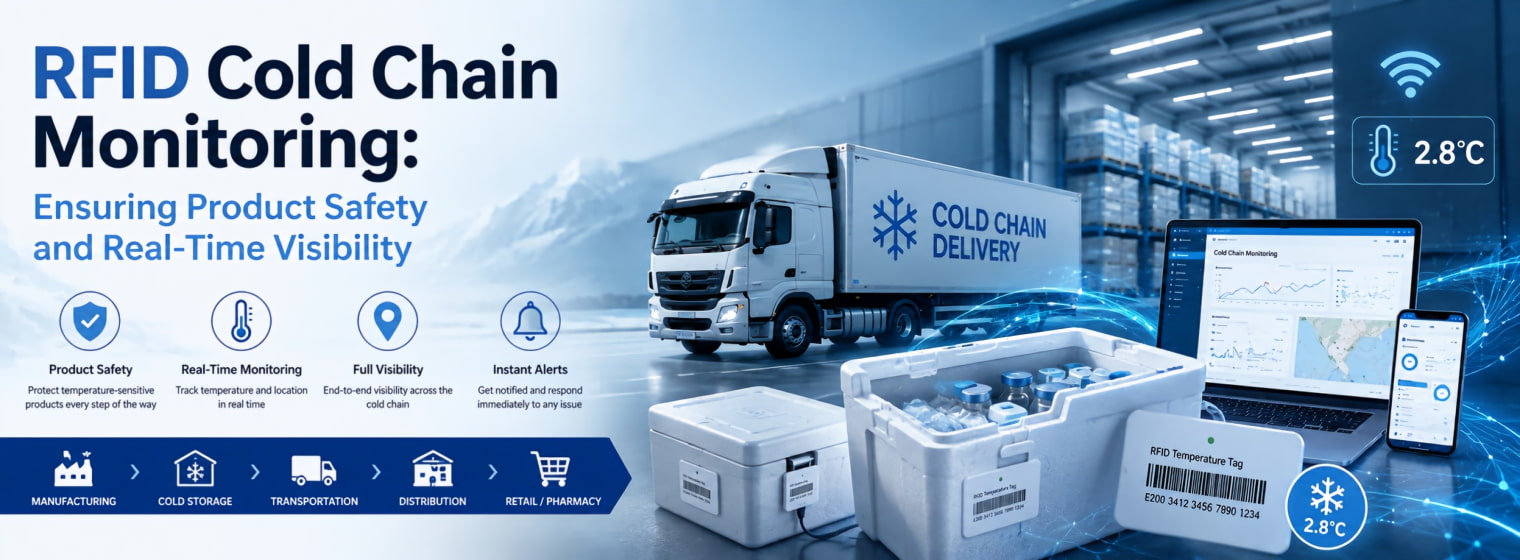
Cold chain logistics plays a critical role in industries such as food, pharmaceuticals, biotechnology, and healthcare. Maintaining the correct temperature throughout storage and transportation is essential to preserve product quality and comply with strict regulatory standards.
Traditional cold chain management often relies on manual inspections and barcode systems, making it difficult to detect temperature deviations in real time. RFID technology provides a smarter solution by enabling automatic identification, real-time monitoring, and complete traceability across the entire cold chain.
This article explores how RFID cold chain monitoring works, its key benefits, and the industries that benefit most from its implementation.
RFID Cold Chain Monitoring is a system that combines RFID tags, RFID readers, sensors, and management software to monitor products throughout temperature-controlled storage and transportation.
Unlike traditional labels, RFID tags can store detailed product information and communicate wirelessly without direct line-of-sight. When integrated with temperature sensors, RFID tags can continuously record environmental conditions and automatically transmit data to management systems.
This enables companies to monitor inventory status, temperature history, product location, and transportation conditions in real time.
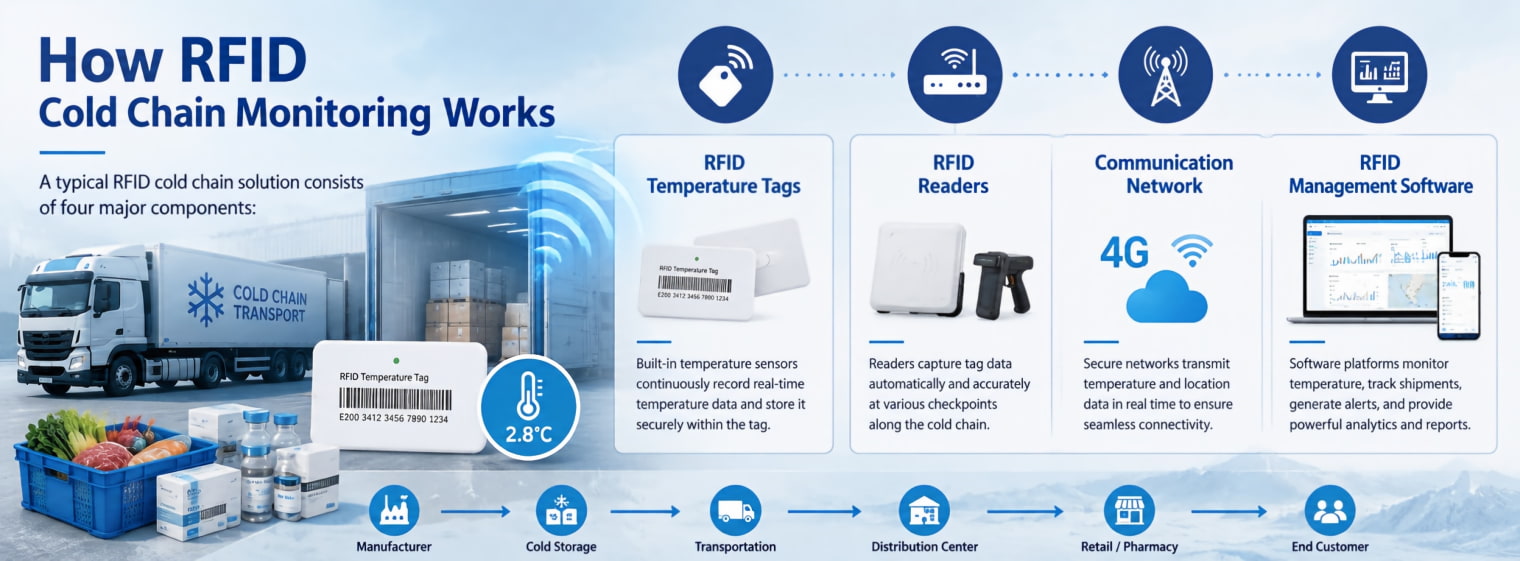
A typical RFID cold chain solution consists of four major components:
Products or containers are attached with RFID temperature monitoring tags that record environmental data, including:
Some RFID tags include built-in sensors that continuously log temperature during transportation.
Fixed or handheld RFID readers automatically collect information at various checkpoints such as:
Data is captured without opening packages or manually scanning labels.
Collected RFID data is transmitted through Wi-Fi, Ethernet, 4G/5G, or cloud platforms for centralized management.
The software platform provides:
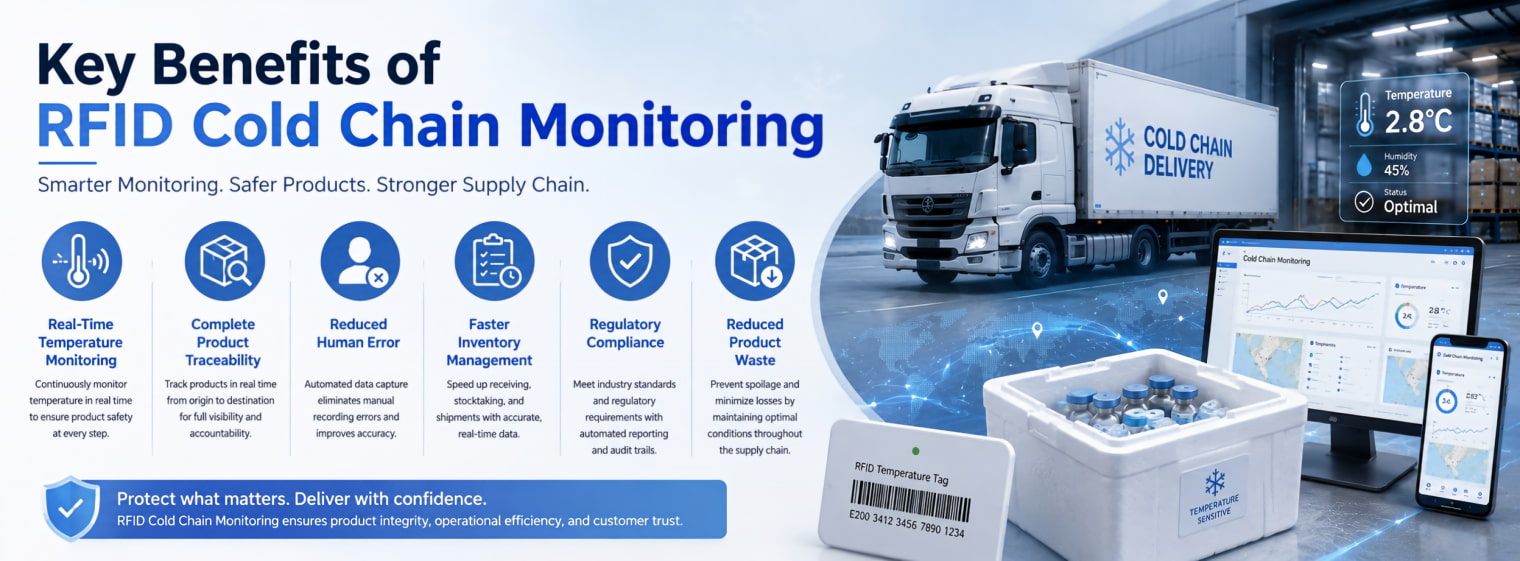
RFID continuously monitors storage and transportation temperatures.
If temperatures exceed predefined limits, the system immediately sends alerts, allowing operators to take corrective actions before products are damaged.
Every movement of each product is automatically recorded.
Businesses can quickly identify:
This simplifies recalls and quality investigations.
Traditional manual recording is prone to mistakes.
RFID automates:
Automation improves accuracy while reducing labor costs.
RFID readers can identify hundreds of tagged items simultaneously.
Warehouse staff no longer need to scan products individually, significantly improving receiving, picking, and shipping efficiency.
Industries such as pharmaceuticals and food processing must comply with strict cold chain regulations.
RFID systems automatically generate complete audit trails that support compliance with industry standards and customer requirements.
Early detection of temperature deviations prevents spoilage.
Companies can isolate affected products immediately rather than discarding entire shipments, reducing financial losses.
RFID protects temperature-sensitive medicines, vaccines, insulin, and biologics during storage and transportation.
Benefits include:
Fresh food requires continuous temperature control from production to retail.
RFID helps monitor:
Hospitals use RFID to monitor:
Real-time monitoring improves patient safety.
Biological samples often require extremely stable storage conditions.
RFID provides continuous environmental monitoring and historical records for research laboratories.
Third-party logistics providers use RFID to improve:
A standard RFID cold chain process includes:
| Feature | Barcode | RFID |
|---|---|---|
| Line-of-sight required | Yes | No |
| Multiple tag reading | No | Yes |
| Temperature monitoring | No | Yes (sensor tags) |
| Real-time tracking | Limited | Yes |
| Automatic inventory | No | Yes |
| Data storage | Limited | Larger capacity |
| Durability | Moderate | Excellent |
RFID offers significant advantages for cold chain environments where speed, automation, and continuous monitoring are essential.
When selecting an RFID system, businesses should consider:
The right solution depends on the products being transported and the operating environment.
As IoT, cloud computing, and artificial intelligence continue to evolve, RFID cold chain systems are becoming increasingly intelligent.
Future developments include:
These innovations will further improve supply chain transparency and operational efficiency.
RFID Cold Chain Monitoring is transforming how businesses manage temperature-sensitive products. By combining automatic identification, real-time monitoring, and complete traceability, RFID helps reduce product loss, improve operational efficiency, and ensure regulatory compliance.
Whether managing pharmaceuticals, fresh food, healthcare products, or biotechnology materials, RFID provides the visibility and control needed to maintain product integrity throughout the entire cold chain.
Investing in RFID cold chain monitoring not only enhances product safety but also strengthens customer trust and supports long-term business growth.

one-stop rfid hardware solution provider.

Support email contact.

Professional technical guidance.
leave a message
Scan to wechat :

Scan to Whatsapp :