one-stop rfid hardware solution provider.

Leave A Message
If you are interested in our products and want to know more details,please leave a message here,we will reply you as soon as we can.


The fashion and apparel industry is one of the earliest and most successful adopters of RFID technology. With thousands of garments moving through factories, warehouses, distribution centers, retail stores, and fitting rooms every day, traditional barcode systems often struggle to provide the speed, accuracy, and visibility required by modern retailers.
RFID Apparel Tracking enables every garment to carry a unique digital identity through an RFID tag or RFID hang tag. Unlike conventional barcodes, RFID tags can be read automatically without direct line of sight and multiple items can be identified simultaneously. This allows retailers to monitor inventory in real time, improve replenishment efficiency, reduce manual labor, and significantly increase inventory accuracy.
Whether managing seasonal collections, luxury fashion, sportswear, footwear, or department stores, RFID technology helps retailers create a more connected, efficient, and customer-focused shopping experience.
Fashion retailers face a variety of inventory management challenges that directly affect sales performance and customer satisfaction.
Manual inventory counting frequently results in discrepancies between system records and actual stock levels, making it difficult to maintain accurate inventory visibility.
Traditional barcode scanning requires employees to scan each garment individually, making full inventory counts time-consuming and labor-intensive.
Products may still be available in the stockroom but unavailable on the sales floor due to delayed replenishment.
The fashion industry suffers from inventory losses caused by theft, misplaced products, and inaccurate stock records.
Without real-time tracking, retailers cannot efficiently monitor garments throughout manufacturing, distribution, and retail operations.
RFID technology transforms apparel inventory management from a manual process into an automated, data-driven workflow.
Compared with barcode systems, RFID offers significant advantages:
| Barcode | RFID |
|---|---|
| Line-of-sight scanning | Contactless reading |
| One item at a time | Hundreds of garments simultaneously |
| Manual operation | Automatic identification |
| Limited visibility | Real-time inventory |
| Low efficiency | High-speed inventory counting |
Retailers using RFID typically achieve:
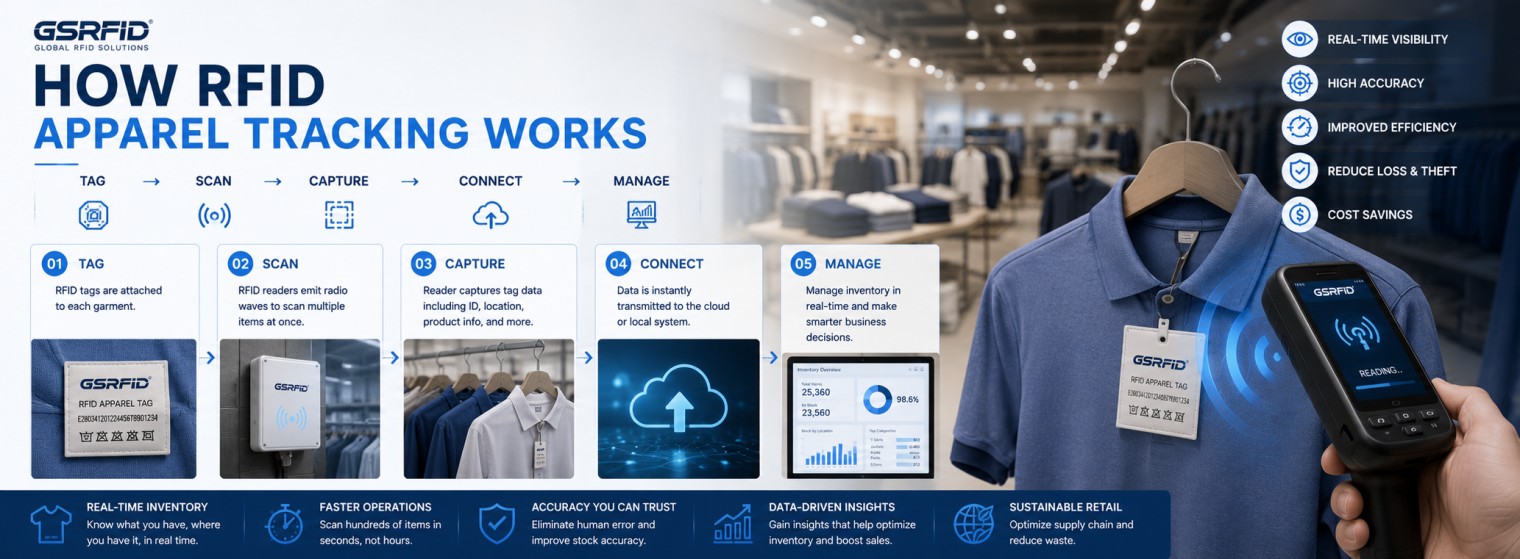
The RFID apparel tracking system consists of several integrated components working together to provide real-time garment visibility.
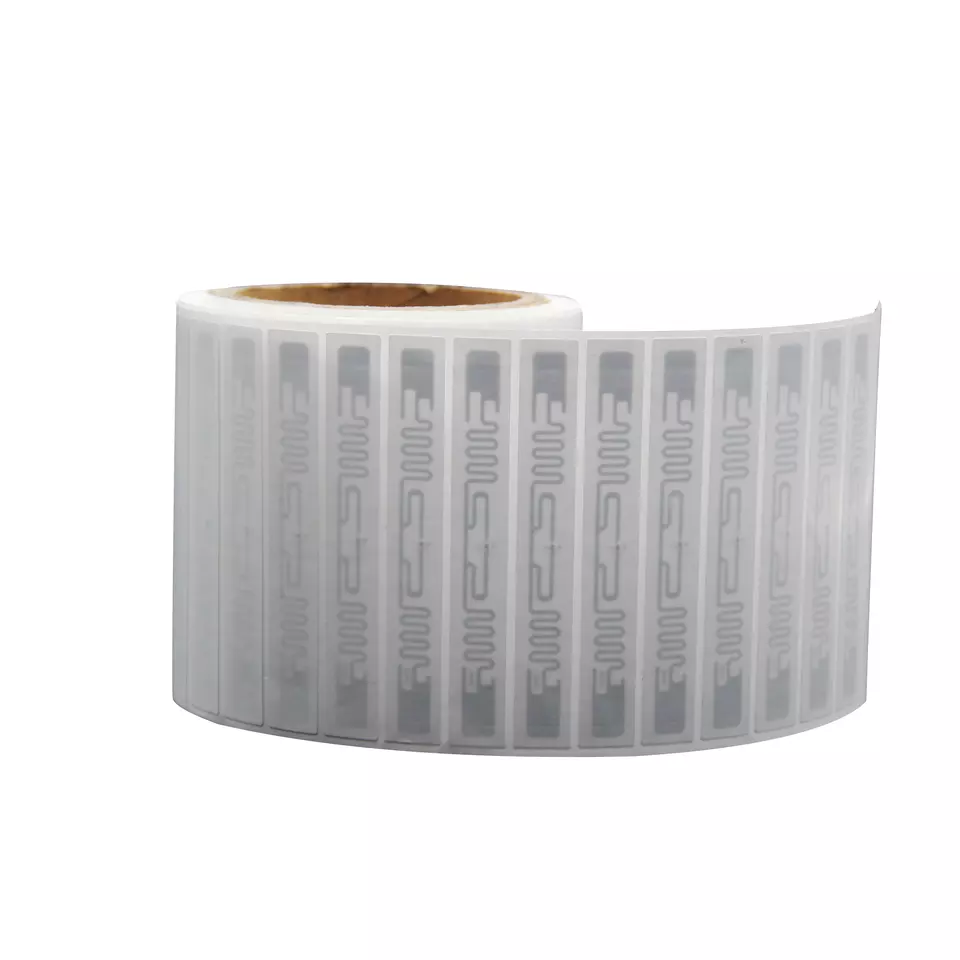
Each garment receives a unique RFID UHF hang tag or washable RFID label during manufacturing or packaging.
↓
Garments are automatically identified during production, warehousing, transportation, and retail operations.
↓
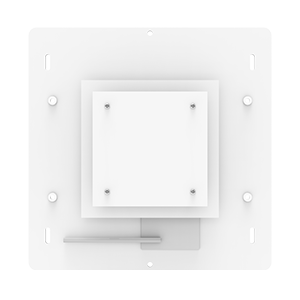
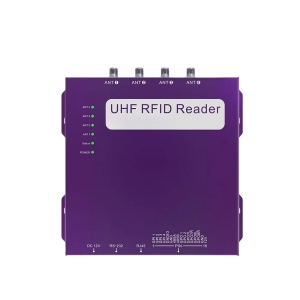
Fixed RFID readers monitor products entering and leaving warehouses, fitting rooms, checkout counters, and store exits.
↓
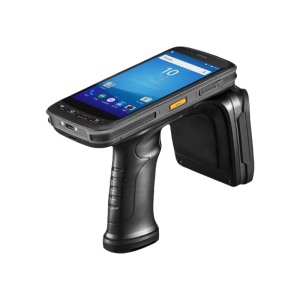
Handheld RFID readers enable employees to perform rapid inventory counting and locate missing garments.
↓
Inventory information is synchronized with ERP, POS, WMS, or retail management software for real-time stock visibility.
Implementing RFID technology in apparel retail brings measurable improvements across inventory management, store operations, and customer service. Compared with traditional barcode systems, RFID delivers a smarter and more scalable solution for fashion retailers of all sizes.
RFID enables item-level tracking throughout the supply chain, allowing retailers to maintain inventory accuracy rates of up to 99%. Accurate inventory data reduces stock discrepancies and supports better business decisions.
Instead of scanning garments one by one, RFID readers can identify hundreds of tagged products simultaneously. A complete store inventory that once required several employees working overnight can now be completed in less than an hour.
Real-time inventory visibility allows store associates to identify low-stock items immediately. Products can be replenished before shelves become empty, helping retailers maximize sales opportunities.
Modern consumers expect services such as Buy Online, Pick Up In Store (BOPIS), Click & Collect, and Ship-from-Store. RFID provides accurate inventory visibility across all channels, ensuring orders are fulfilled quickly and accurately.
RFID helps retailers monitor product movement at every stage of the supply chain. Suspicious inventory movements can be identified more easily, reducing shrinkage caused by theft, loss, or operational errors.
When customers can easily find the right size and style in stock, overall satisfaction increases. Store staff can also locate products faster using handheld RFID readers, providing better customer service.
RFID generates valuable operational data, including inventory turnover, product movement, replenishment frequency, and sales trends. This information enables retailers to optimize merchandising strategies and inventory planning.
Although RFID requires an initial investment, many retailers recover their costs through reduced labor expenses, improved inventory accuracy, higher sales, and lower inventory losses.
RFID Apparel Tracking is widely adopted across various sectors of the fashion industry.
Large retail brands use RFID to monitor inventory across hundreds of stores, ensuring consistent stock availability and efficient replenishment.
Luxury brands use RFID for inventory control, product authentication, and anti-counterfeiting while improving customer service.
Sportswear retailers manage frequent product launches and seasonal collections more efficiently using RFID-enabled inventory systems.
Department stores benefit from centralized inventory visibility across multiple brands and product categories.
Manufacturers attach RFID tags during production, enabling end-to-end garment traceability from factory to retail store.
RFID accelerates receiving, sorting, picking, packing, and shipping processes, significantly improving warehouse efficiency.
Selecting the right RFID tag is essential for achieving optimal system performance.
| Application | Recommended RFID Product |
|---|---|
| T-Shirts | UHF RFID Hang Tag |
| Jeans | RFID Care Label |
| Jackets | Woven RFID Label |
| Shoes | RFID Shoe Label |
| Accessories | RFID Paper Tag |
| Cartons | RFID UHF Shipping Label |
| Pallets | RFID Pallet Tag |
When choosing RFID tags, buyers should consider:
Reading distance requirements
Tag size and installation method
Garment material
Printing requirements
Chip compatibility
EPC memory capacity
Environmental durability
Cost and deployment scale
Our engineering team can recommend the most suitable RFID solution based on your specific application.
As a professional RFID manufacturer, we provide comprehensive OEM and ODM services for apparel brands, retailers, and system integrators.
Customization options include:
Custom dimensions and tag shapes
Company logo printing
EPC encoding
Barcode and QR code printing
Variable data printing
Chip selection (NXP, Impinj, Alien, etc.)
Frequency customization
Packaging customization
Pre-programmed UID and serial numbers
Whether you require small prototype batches or large-volume production, we can deliver reliable RFID products tailored to your business requirements.
A leading European apparel retailer implemented our UHF RFID apparel tracking solution across more than 150 retail stores.
Challenges
Inventory accuracy below 85%
Long inventory counting cycles
Frequent stock discrepancies
Delayed replenishment
Solution
The retailer adopted RFID hang tags, handheld RFID readers, fixed RFID portals, and integrated inventory management software.
Results
Inventory accuracy increased to 99%
Inventory counting time reduced by 90%
Stock replenishment efficiency improved significantly
Out-of-stock incidents reduced by more than 40%
Labor costs lowered through automated inventory processes
The project achieved full return on investment within the first year of deployment.
Choosing the right RFID partner is just as important as selecting the right technology.
We are committed to delivering high-quality RFID products and complete application solutions for customers worldwide.
Professional RFID manufacturer with extensive industry experience
Complete product portfolio including RFID tags, cards, wristbands, readers, antennas, and accessories
Strong OEM & ODM capabilities
Advanced production equipment and strict quality control
Competitive factory pricing
Fast production and worldwide shipping
Experienced engineering and technical support
Flexible customization for different industries
From sample development to mass production, we help customers successfully implement RFID projects with confidence.
UHF RFID is the most widely used technology because it offers long reading distances, fast multi-tag reading, and excellent performance in retail environments.
Yes. RFID can be integrated into woven labels, care labels, or fabric labels for permanent garment identification.
Some hard RFID tags can be reused, while paper hang tags are generally designed for single-use retail applications.
Yes. Many retailers use hybrid labels containing both RFID chips and printed barcodes to support gradual system upgrades.
Yes. RFID solutions can integrate with ERP, WMS, POS, MES, and other enterprise management systems through middleware or APIs.
Typical UHF RFID systems provide reading distances ranging from 3 to 10 meters, depending on the reader, antenna, and installation environment.
Yes. We support custom chip selection, logo printing, encoding, packaging, and private-label manufacturing.
Yes. We offer RFID tags, readers, antennas, printers, and related accessories to build complete apparel tracking systems.
Ready to modernize your apparel inventory management?
Whether you are a fashion brand, retailer, distributor, or RFID system integrator, our experienced team can provide complete RFID apparel tracking solutions tailored to your business.
Contact us today to request a quotation, receive free technical consultation, or discuss your custom RFID project.

one-stop rfid hardware solution provider.

Support email contact.

Professional technical guidance.
leave a message
Scan to wechat :

Scan to Whatsapp :